
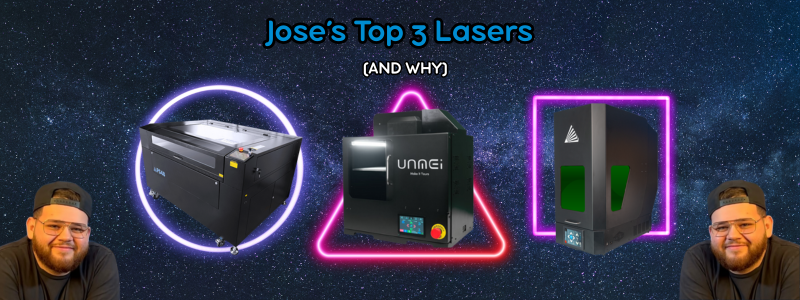
When people ask me what lasers I personally recommend, I always tell them the same thing: it depends on what you want to make — but there are a few machines I keep coming back to because they consistently deliver results. Over the years, I’ve worked with a wide range of laser systems, from traditional CO₂ cutters to high-speed galvo markers and advanced AI-powered platforms. Some are great for specific jobs, but only a few truly change the way you work.
These three lasers stand out because they each dominate their category. They’ve earned a permanent place in my workflow based on performance, reliability, and the range of projects they make possible. From entry-level production to precision industrial engraving, these are my top three favorite lasers, ranked from least to best based on how much they improve efficiency and quality in real-world use.
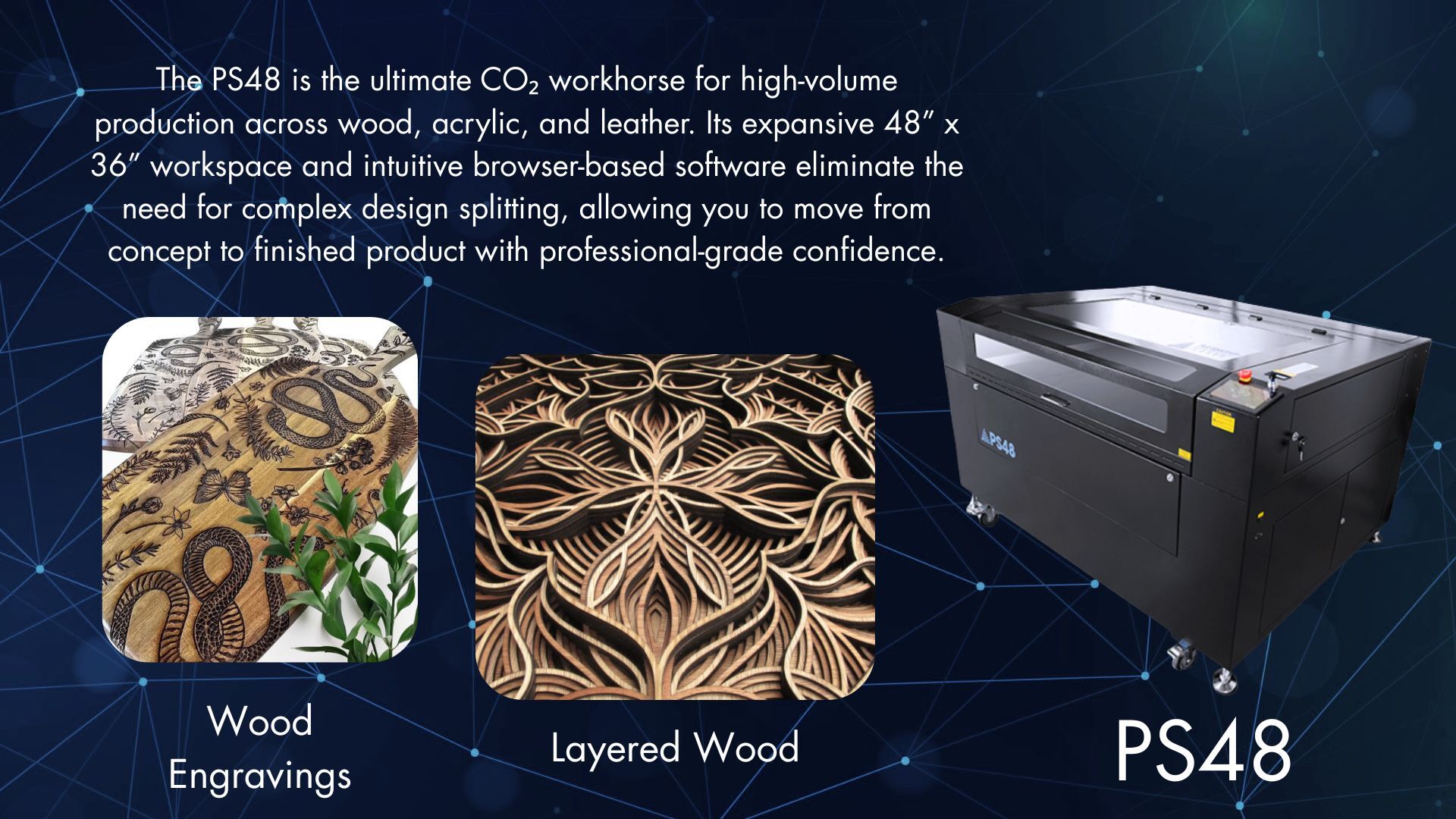
PS48 – A Reliable CO₂ Workhorse
The PS48 takes the third spot on my list because it represents everything a professional CO₂ laser should be: simple, powerful, and versatile. When I’m cutting or engraving wood, acrylic, leather, rubber, or coated materials, this is the machine I reach for first. Its large 48” x 36” working area makes it ideal for signage, large panels, and batch production without having to tile designs or split files into sections.
One of the biggest reasons I like the PS48 is its balance between size and usability. It’s large enough to handle serious work but still straightforward to operate. The browser-based software keeps the learning curve low, which means less time fighting with settings and more time making products. Whether you’re engraving logos into wooden plaques or cutting acrylic letters for a storefront, the PS48 handles everyday shop tasks with confidence.
Another advantage of the PS48 is how expandable it is. With optional pass-through doors and a motorized Z table, it adapts to oversized materials and thicker stock without forcing you to compromise your designs. That flexibility makes it a strong choice for shops that don’t want to outgrow their first serious CO₂ laser too quickly.
The reason the PS48 sits at number three on my list isn’t because it lacks power — it’s because CO₂ lasers naturally have material limitations. You won’t be engraving bare metals with it, and it won’t match the speed of a galvo system for marking. But for what it’s built to do — cutting and engraving non-metal materials — it does its job extremely well. That’s why it earns its place as a foundation machine for many shops.
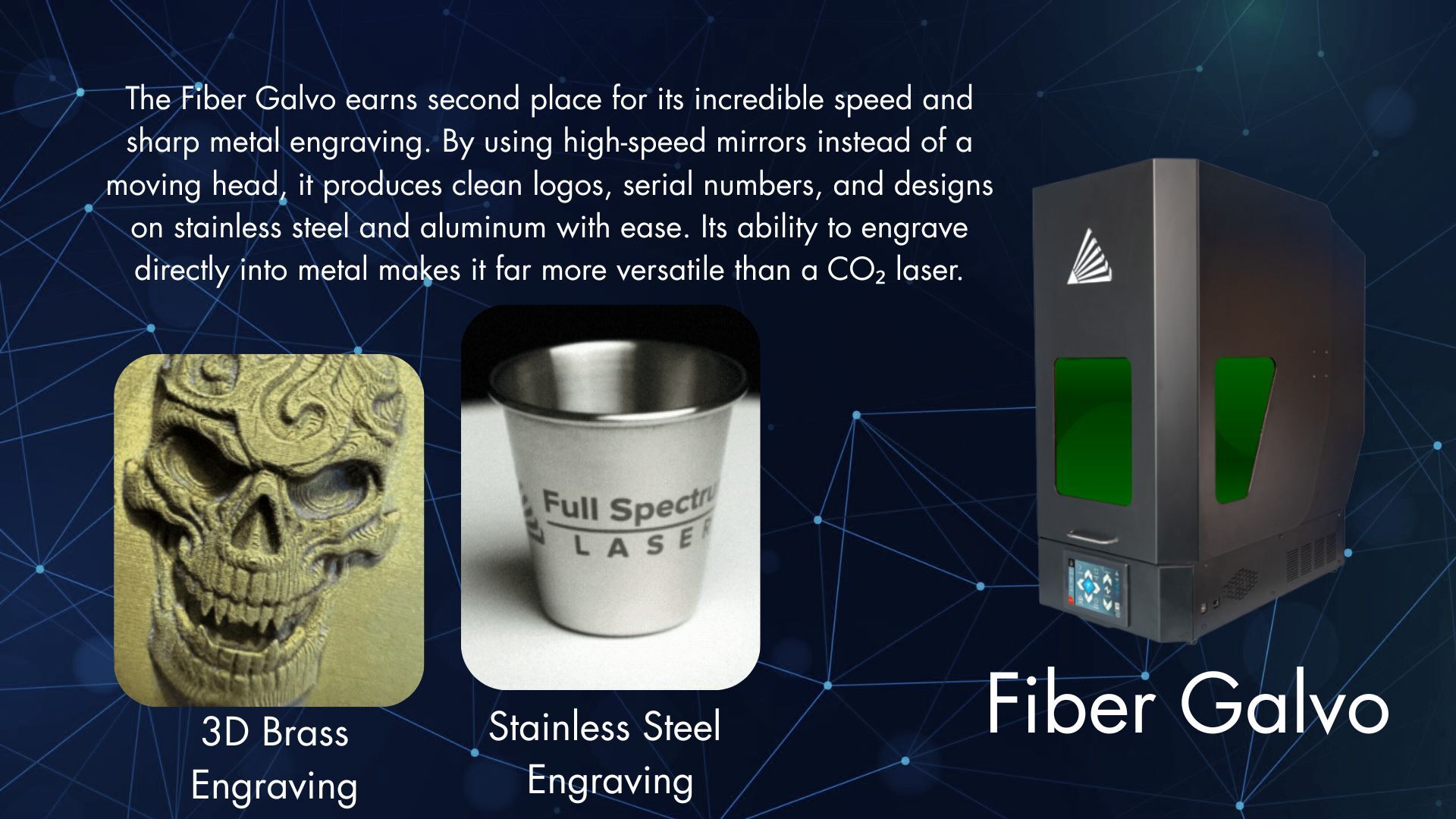
Fiber Galvo – Speed, Detail, and Metal Control
Moving into second place is the Fiber Galvo, and this is where things really start to get exciting. The first time you use a galvo system after working on gantry lasers, the speed difference feels unreal. Instead of physically moving the laser head across the work area, the galvo uses fast-moving mirrors to steer the beam instantly. That makes it perfect for engraving and marking applications where detail and efficiency matter.
This laser shines when working with metals like stainless steel, aluminum, brass, and coated materials. It’s ideal for logos, QR codes, serial numbers, nameplates, and decorative metal engraving. With a MOPA fiber configuration, you can even adjust pulse settings to achieve different contrast effects and surface finishes, which opens up creative possibilities that standard fiber systems can’t easily match.
What I love most about the Fiber Galvo is how it bridges the gap between creative engraving and industrial production. On one hand, it’s precise enough for artistic designs and fine line work. On the other hand, it’s fast enough to handle repeat jobs at scale without slowing your workflow. That combination makes it incredibly valuable for businesses that need both quality and throughput.
Another reason this laser ranks above the PS48 for me is material flexibility. While CO₂ systems dominate wood and acrylic, fiber galvos take over when metal enters the picture. Being able to engrave directly into metal rather than just marking coatings or paints dramatically expands the types of products you can offer — from tools and jewelry to industrial parts and branded hardware.
The only reason the Fiber Galvo isn’t number one on my list is because it’s primarily a 2D marking system. It excels on flat parts and known surfaces, but when you start dealing with curved objects or variable shapes, setup can become more involved. That’s where my top pick truly separates itself.
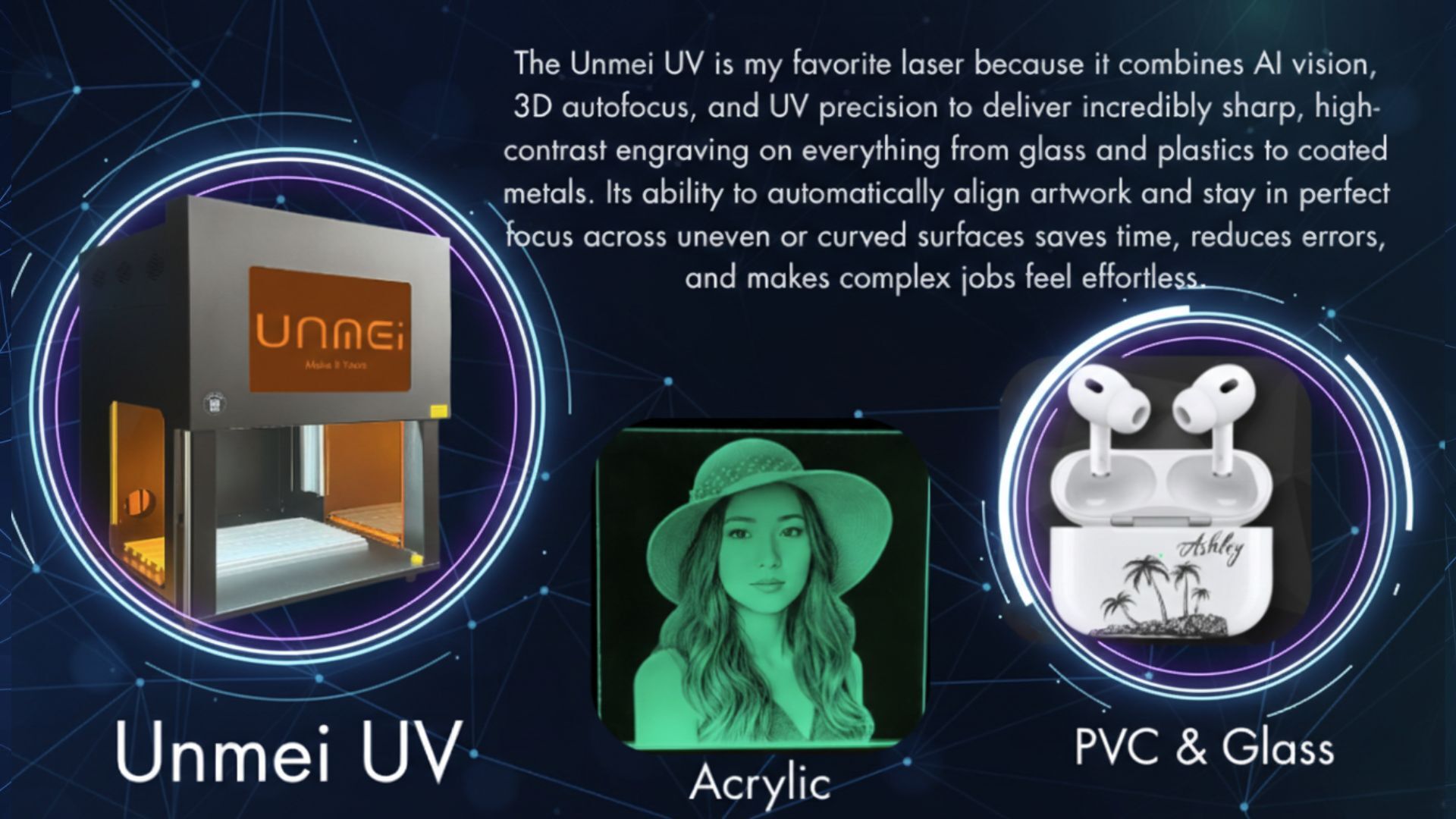
Unmei UV – Precision
What makes the Unmei UV one of my absolute favorite lasers is how effortlessly it delivers extreme precision across a wide range of materials. This isn’t just a faster system — it’s a smarter one. With built-in AI vision, 3D autofocus, and Whole Lens Correction, the Unmei UV automatically identifies the object, aligns the artwork, and maintains perfect focus even on curved or uneven surfaces. That means I spend far less time setting up jobs and far more time producing clean, repeatable results. The UV wavelength is especially powerful for fine-detail engraving and high-contrast marking, allowing me to work on materials like glass, plastics, ceramics, coated metals, and sensitive surfaces without excessive heat or damage.
From a production standpoint, the Unmei UV changes the way I work. Instead of manually measuring, positioning, and test-firing parts, the camera system handles alignment for me and compensates for height differences across the entire engraving field. This makes it ideal for complex parts, cylindrical items, and irregular shapes that would normally require custom fixtures or tedious adjustments. The result is faster turnaround, fewer scrapped pieces, and consistent quality across every batch. It feels less like operating a traditional laser and more like using an intelligent tool that understands what I’m trying to achieve. That combination of accuracy, material flexibility, and automation is exactly why the Unmei UV has become one of the most trusted machines in my lineup. ? https://fslaser.com/unmei-uv/
Why These Three Lasers Stand Above the Rest
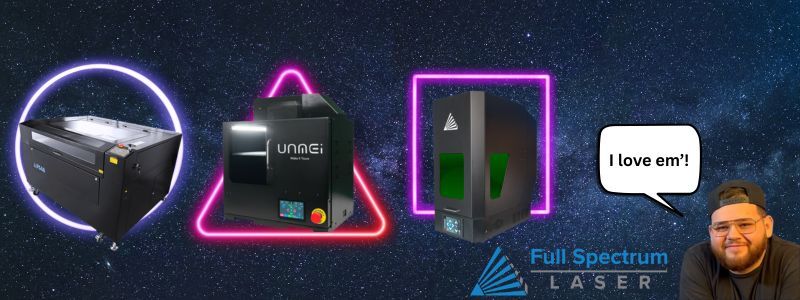
Each of these lasers earns its spot for a different reason. The PS48 gives you dependable CO₂ cutting and engraving for non-metal materials. The Fiber Galvo brings high-speed marking and true metal engraving into your shop. And the Unmei represents the next generation of laser technology with AI-assisted alignment and 3D precision.
Together, they cover an enormous range of applications — from signs and awards to tools, parts, and decorative products. More importantly, they scale with your business. You can start with CO₂, move into fiber, and eventually step into AI-powered systems without changing the core workflow philosophy.
These machines don’t just increase what you can make — they increase how efficiently and consistently you can make it. That’s why they’re my top three favorites, and why I recommend them to anyone serious about upgrading their laser operation.