
2D vs. 3D Galvo Lasers:
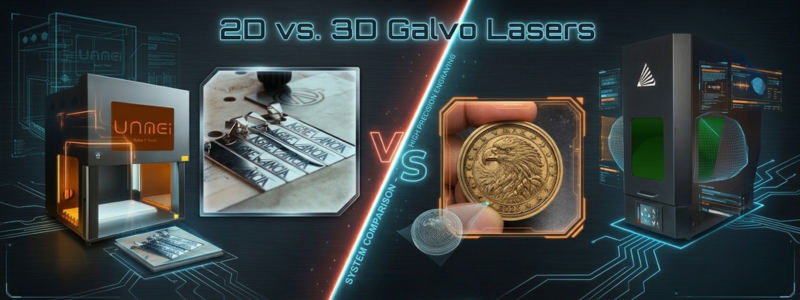
2D vs. 3D Galvo Lasers: Understanding Full Spectrum Laser’s High-Speed Engraving Technology
Laser engraving technology has evolved rapidly over the past decade, and galvo laser systems have become one of the fastest and most precise tools available for industrial marking and engraving. Instead of physically moving a laser head across a work area like a traditional gantry system, galvo lasers use high-speed mirrors to steer the beam across the material. This approach allows the laser to reposition almost instantly, making it ideal for applications that require high-speed marking, detailed engraving, and repeatable accuracy.
At Full Spectrum Laser, galvo systems support both 2D and 3D scanning technologies, each designed for different types of applications. Understanding the technical differences between these two configurations can help manufacturers and creators choose the right system for their workflow.
What Is a Galvo Laser System?
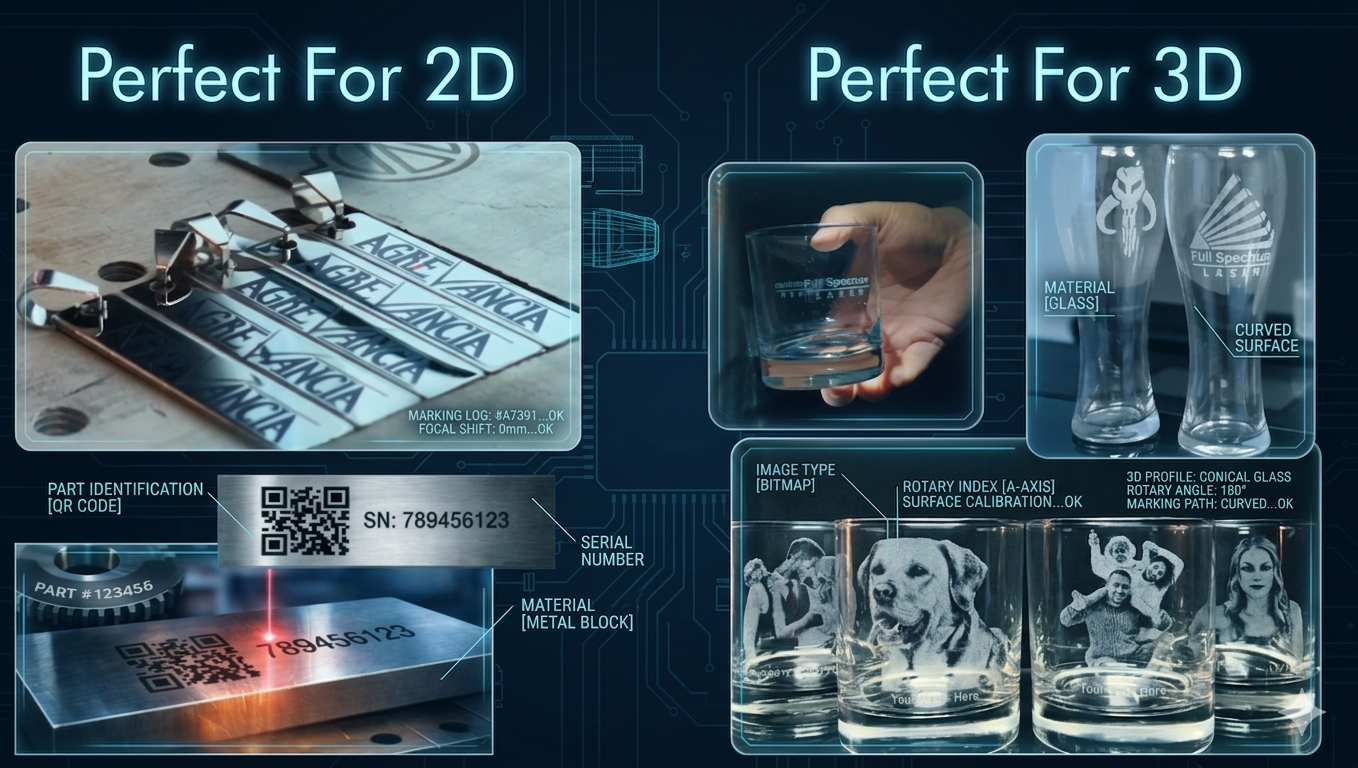
A galvanometer (galvo) laser system uses motor-driven mirrors to rapidly redirect the laser beam across a work surface. Because the mirrors move instead of the entire laser head, the beam can travel across the marking field at extremely high speeds while maintaining precise positioning.
This design is why galvo systems are widely used for:
- Industrial part marking
- Serial numbers and QR codes
- High-speed engraving
- Product branding and traceability
- Precision micro-processing
While all galvo systems rely on mirror scanning, the key distinction comes down to how the system handles focus and surface depth, which is where the difference between 2D and 3D galvo systems becomes important.
2D Galvo Lasers: Fast Precision on Flat Surfaces
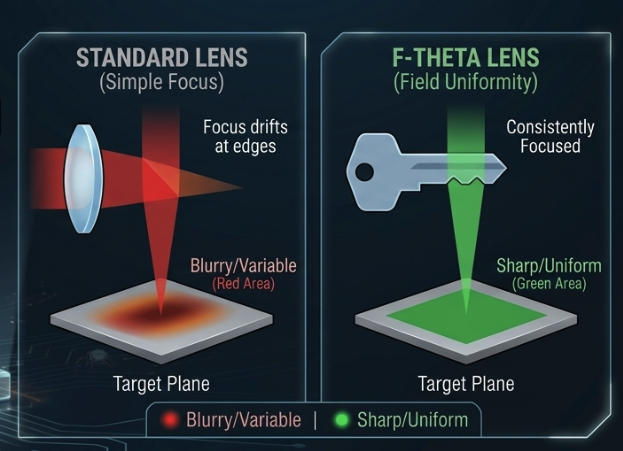
A 2D galvo laser system controls the beam across the X and Y axes, scanning over a flat work plane. Because the beam angle changes as the mirrors move, a special optical component called an F-theta lens is required to maintain consistent focus across the entire marking area.
Without this lens, the beam would only be perfectly focused at the center of the field, while areas near the edges would drift out of focus. The F-theta lens corrects this geometric effect, ensuring the laser stays properly focused across the entire working field from edge to edge.
Thanks to this optical correction, 2D galvo systems deliver extremely consistent engraving quality when working on flat materials with uniform height.
Advantages of 2D Galvo Systems
- Extremely fast marking speeds
- Highly reliable and simple architecture
- Consistent focus across the field using an F-theta lens
- Ideal for flat materials and high-volume production
Common Applications
2D galvo lasers are commonly used for:
- Metal nameplates and industrial tags
- Barcode and QR code engraving
- Serial number marking
- Electronics labeling and PCB marking
- Flat product branding and logos

For manufacturers working primarily with flat parts or sheet materials, a 2D galvo system offers one of the fastest and most efficient marking solutions available.
3D Galvo Lasers: Dynamic Focus and Surface Flexibility
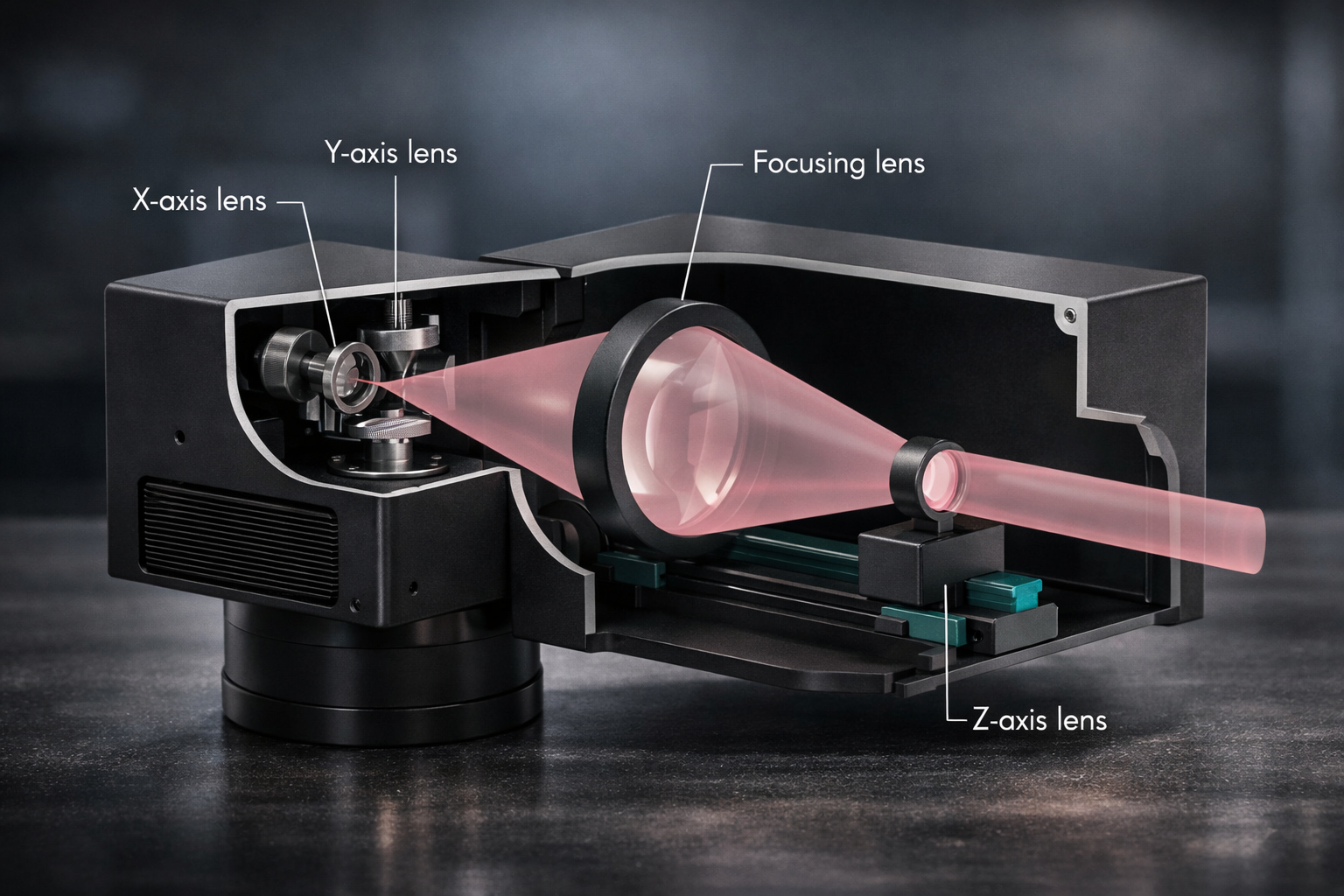
A 3D galvo system, sometimes called a 3-axis galvo, expands on this concept by adding dynamic Z-axis focus control. Instead of relying solely on a fixed optical plane, the system actively adjusts the focus position as the laser scans.
This allows the laser to remain sharply focused even when engraving curved, angled, or stepped surfaces.
In addition to dynamic focus control, a 3D galvo system also performs field flattening, correcting optical distortion across the marking area. Because of this capability, a 3-axis galvo system can be designed with or without an F-theta lens, depending on the optical architecture used.
This added flexibility gives 3D galvo systems a much wider range of processing capabilities.
Advantages of 3D Galvo Systems
- Dynamic Z-axis focus adjustment
- Ability to engrave curved or uneven surfaces
- Field flattening across large marking areas
- Greater flexibility for complex geometries
- Consistent beam quality across varying depths
Advanced Applications
3D galvo systems are often used in advanced manufacturing environments where surfaces are not perfectly flat. Typical applications include:
- Mold engraving and tool texturing
- Curved metal component marking
- Automotive part identification
- Jewelry engraving
- Medical device manufacturing
- Aerospace component processing
Because the system automatically adjusts the focal point during scanning, it can engrave complex parts without requiring constant repositioning or manual focus adjustments.
Full Spectrum Laser’s Approach to Galvo Technology
Full Spectrum Laser develops galvo platforms that support both high-speed industrial marking and advanced multi-surface engraving.
For businesses focused on high-volume flat marking, 2D galvo systems provide exceptional speed and efficiency thanks to their optimized optical path and F-theta lens design.
For more advanced manufacturing environments, 3D galvo systems unlock additional capabilities, allowing users to engrave across curved surfaces, multi-level parts, and complex geometries while maintaining consistent beam quality across the entire working field.
This flexibility allows manufacturers to move beyond simple flat marking and into true three-dimensional laser processing.
Choosing Between 2D and 3D Galvo Systems
The right system ultimately depends on the types of parts being processed.
|
Application |
Recommended System |
|
Flat metal tags and plates |
2D Galvo |
|
High-volume barcode marking |
2D Galvo |
|
Curved or angled components |
3D Galvo |
|
Deep engraving and molds |
3D Galvo |
|
Multi-height industrial parts |
3D Galvo |
In general:
- 2D galvo systems prioritize speed and efficiency on flat surfaces
- 3D galvo systems provide flexibility and precision across complex geometries
The Future of High-Speed Laser Processing
As manufacturing demands continue to evolve, galvo laser systems are becoming increasingly important for high-precision production environments. By combining high-speed mirror scanning with advanced optical correction and dynamic focusing technologies, modern galvo systems are capable of processing parts that once required multiple machines or manual setups.
With both 2D and 3D galvo platforms available, Full Spectrum Laser provides tools that allow businesses to scale from simple marking applications to highly complex multi-surface laser processing — all while maintaining the speed and precision that galvo technology is known for.